
Best Translation APIs for Developers (2026 Edition)

In 2026, choosing the best translation API is no longer about asking "Which one translates words more accurately?"
That debate is over.
Today, developers, CTOs, and product teams are asking a much more strategic question:
- Should I use a deterministic Translation API (NMT) or a generative AI model (LLM) for localization?
Modern products don't just need translation. They need localization intelligence:
- Preserved layouts and formatting 📄
- Domain-specific terminology 🧠
- Brand tone and cultural nuance 🎯
- Privacy and data sovereignty 🔐
- Predictable costs at scale 💸
As localization stacks grow more complex—often involving multiple providers—teams also need solid API infrastructure, authentication, and monitoring to keep everything reliable.
This guide explores the Best Translation APIs for 2026, explains LLM vs NMT for localization, and helps you build a future-proof translation stack—without vendor lock-in.
The 2026 Translation Paradigm: NMT vs LLM ⚖️
Before comparing vendors, it's critical to understand the two dominant translation approaches used today.
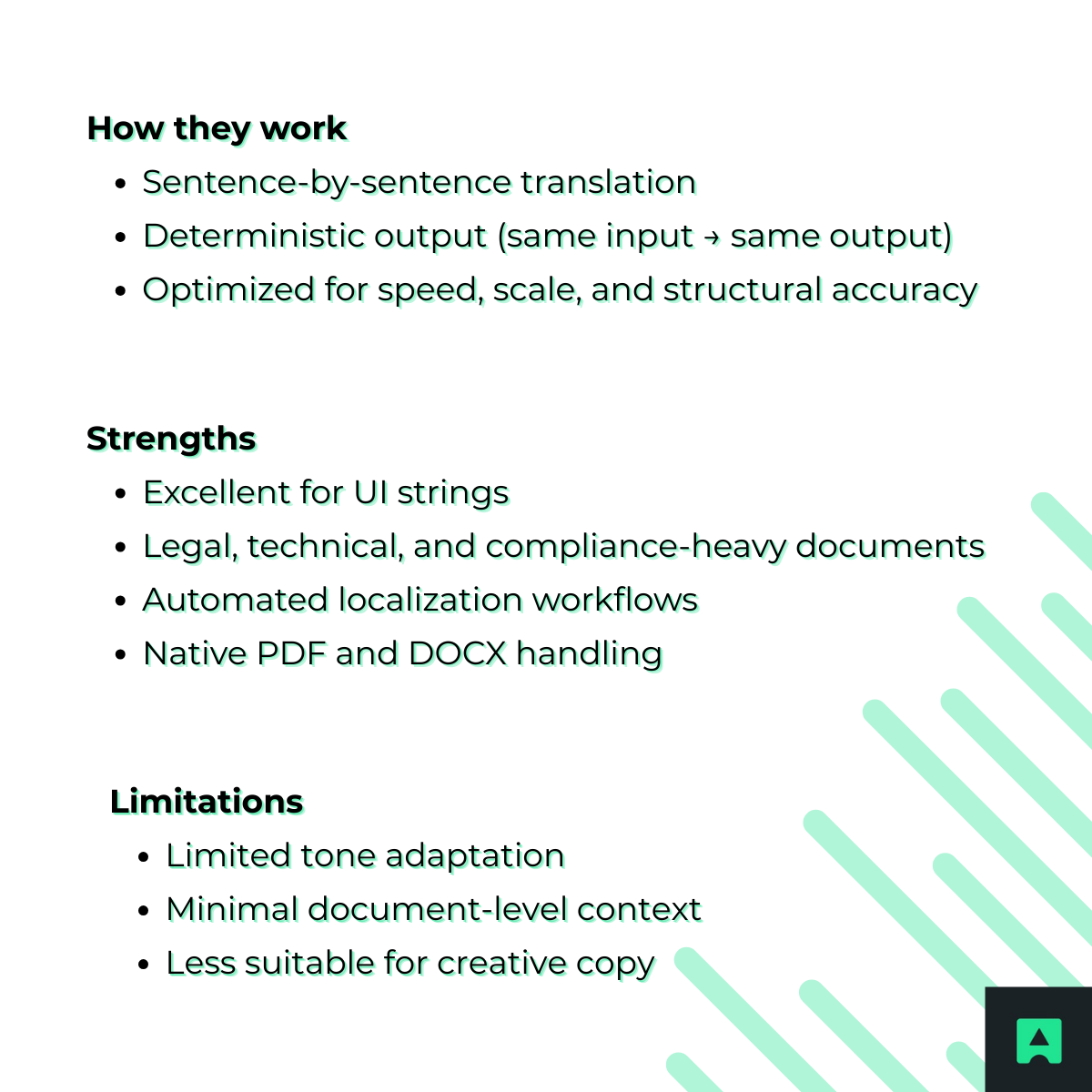
Deterministic NMT APIs (The Operational Backbone)
Examples: Google Translate API, DeepL, Amazon Translate
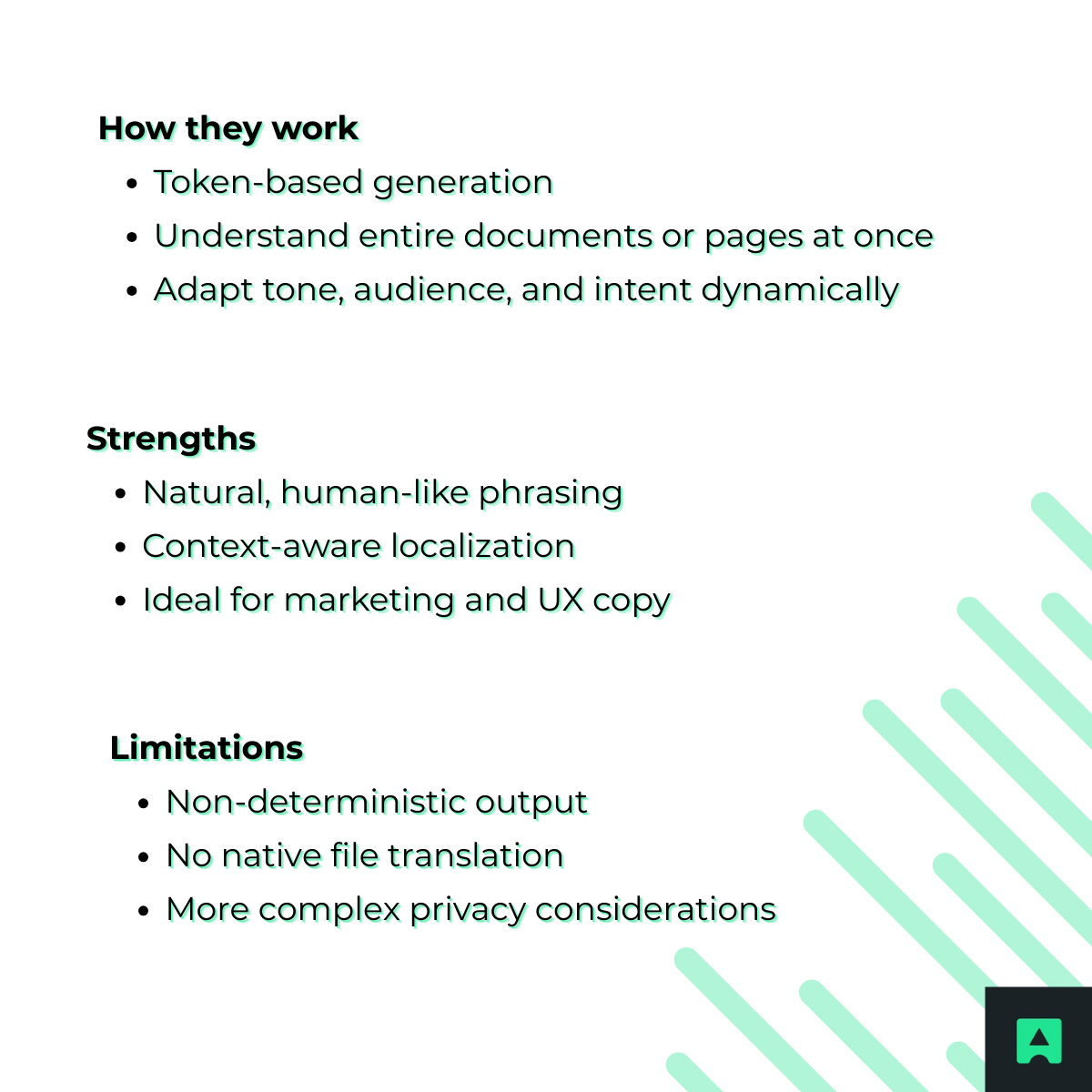
Probabilistic LLMs (The Creative Layer)
Examples: OpenAI GPT-5.2, Anthropic Claude
💡 Key takeaway:
In 2026, the strongest localization stacks combine NMT for structure and LLMs for creativity.
In practice, this often means routing requests dynamically between multiple providers—a challenge that's much easier to solve when APIs are abstracted behind a single gateway.
- 🔗 Learn more about how API gateways simplify multi-provider architectures.
Vendor Cheat Sheet: The Big 5 Translation APIs (2026) 🧩
1. Google Cloud Translation API — The Hybrid Giant
2026 Identity
A large-scale NMT platform increasingly enhanced by Gemini.
Key Technical Updates
- Adaptive Translation powered by Gemini
- Real-time glossary learning
- Improved multilingual context handling
Pricing
- Basic NMT: ~$20 per million characters
- Advanced / LLM-enhanced: ~$25 per million characters
- Pricing becomes complex at scale
Pros
- Massive language coverage 🌐
- High reliability
- Strong GCP ecosystem integration
Cons
- Less transparent pricing
- Limited privacy controls
- Formatting preservation weaker than DeepL
Best for: Teams already deeply invested in Google Cloud infrastructure.
2. DeepL API — The Security Vault 🔐
2026 Identity
The most trusted translation API for privacy-first teams.
Key Technical Updates
- DeepL Pro zero-data retention (no content stored or used for training)
- Best-in-class PDF and DOCX formatting preservation
For teams handling sensitive or regulated data, privacy guarantees like zero-data retention are non-negotiable—especially when combined with secure authentication and access controls.
Modern Python Implementation (2026 Standard)
import deepl
import os
# API key via environment variable
translator = deepl.Translator(os.environ.get("DEEPL_AUTH_KEY"))
# Killer feature: document translation with layout preservation
translator.translate_document_from_filepath(
"report.docx",
"report_german.docx",
target_lang="DE"
)
Pros
- Zero-data retention 🔒
- Excellent formatting accuracy
- Simple Python integration
Cons
- Fewer supported languages than Google
- Limited creative flexibility
Best for: Enterprise, legal, and compliance-sensitive document workflows.
3. OpenAI — The Creative Disruptor ✨
2026 Identity
The leader in transcreation and generative localization.
Key Technical Updates
- GPT-5.2 delivers unmatched fluency
- Superior tone, style, and cultural adaptation
Unlike NMT, LLMs can read an entire page or document before translating—ensuring consistency and intent.
LLM Translation with LangChain (Python)
from langchain_openai import ChatOpenAI
from langchain_core.prompts import ChatPromptTemplate
prompt = ChatPromptTemplate.from_template(
"Translate the following marketing email into Spanish. "
"Make it sound exciting and informal:\n\n{text}"
)
llm = ChatOpenAI(
model="gpt-5.2",
temperature=0.3
)
chain = prompt | llm
result = chain.invoke({
"text": "Discover our new summer features and boost your productivity!"
})
print(result.content)
Pros
- Best-in-class creative output 🎨
- Tone and style control
- For short strings, up to 800× cheaper than NMT
Cons
- No native file translation
- Requires text extraction
- Privacy depends on configuration
Best for: Marketing copy, UX text, brand-driven localization.
4. Amazon Translate — The AWS Utility ⚙️
2026 Identity
A practical translation service for AWS-native stacks.
Key Technical Updates
- Active Custom Translation for niche industries
- Deep integration with S3, Lambda, and Comprehend
Pros
- Excellent scalability
- Seamless AWS integration
- Industry-specific customization
Cons
- Output quality less refined
- Not designed for creative use cases
Best for: Teams running localization pipelines entirely on AWS.
5. Microsoft Translator — The Enterprise Fortress 🏰
2026 Identity
Built for governments and regulated industries.
Key Technical Updates
- Containerized deployments
- Offline / on-prem translation
- Native Office 365 workflows
Pros
- Maximum data control
- Works in air-gapped environments
- Enterprise-grade governance
Cons
- Slower innovation cycle
- Less developer-friendly APIs
Best for: Government, healthcare, and highly regulated organizations.
Pricing Reality: Characters vs Tokens 💰
Understanding pricing models is critical when choosing a translation API.
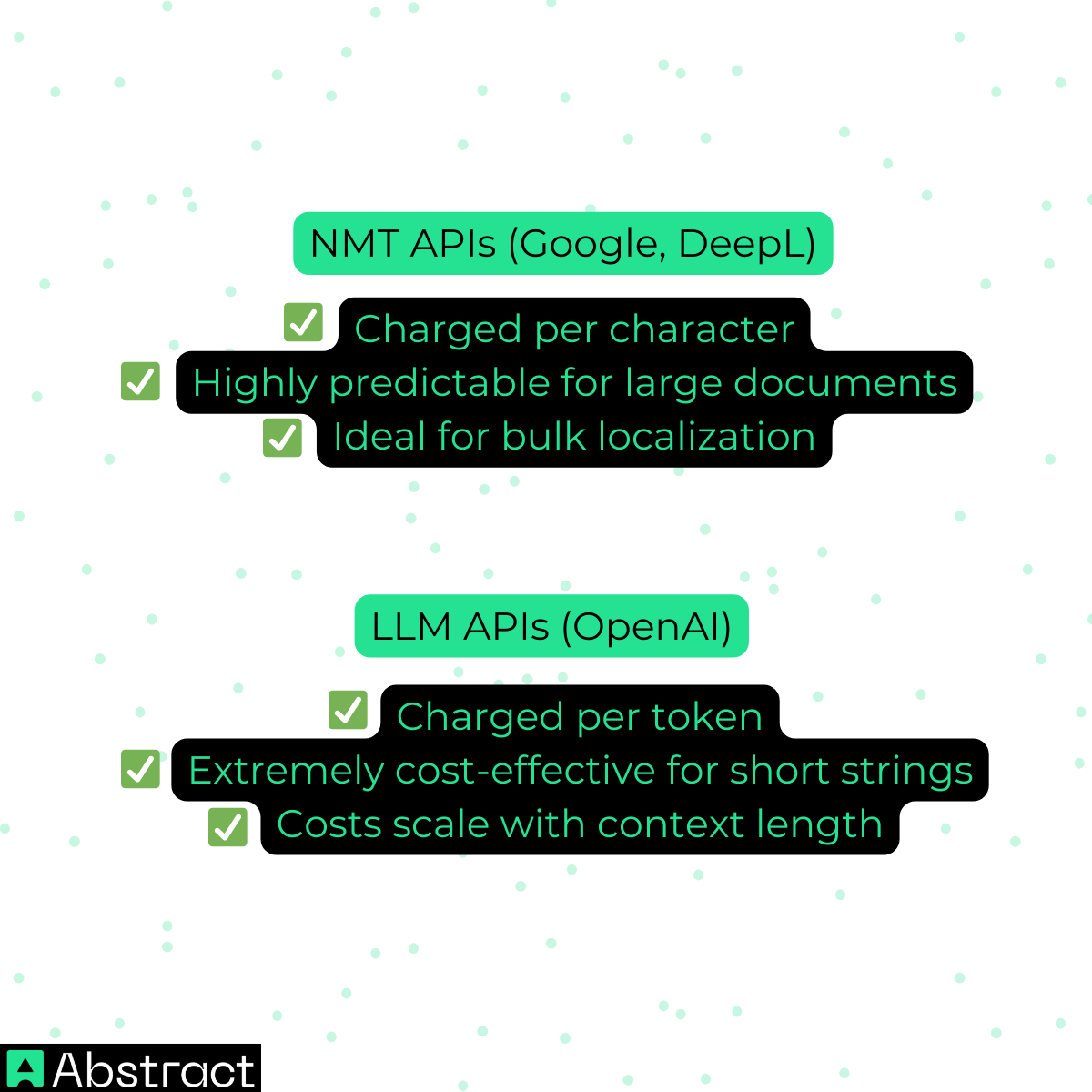
⚠️ For UI strings and microcopy, LLMs can be hundreds of times cheaper.
For long documents, NMT remains more predictable.
Beyond pricing, teams must also manage rate limits, quotas, and usage caps—often across multiple APIs at once.
- 🔗 Read more about rate limiting and why it matters for API-based products:
https://www.abstractapi.com/blog/what-is-an-api-rate-limit
Privacy & Data Sovereignty: A Deal-Breaker in 2026 🔒
Localization often includes:
- Contracts
- Internal documentation
- Customer communications
This is why DeepL Pro's zero-data-retention policy is such a strong differentiator—and why many enterprises restrict sending raw content to general-purpose LLMs without strict safeguards.
When evaluating providers, always confirm:
- Whether data is stored
- Whether content is used for model training
- Where processing takes place
Hybrid Localization Workflows: The 2026 Best Practice 🔄
Leading teams don't rely on a single translation API.
Instead, they combine:
- DeepL or Google for structured content and documents
- LLMs for marketing and UX copy
- A unified abstraction layer to manage authentication, routing, and monitoring
Abstracting these workflows not only simplifies development—it also makes scaling and vendor changes far easier over time.
Simplify Localization Infrastructure with AbstractAPI 🚀
Managing multiple translation providers often means juggling:
- Google API keys 🔑
- DeepL authentication 🔐
- OpenAI tokens 🤯
AbstractAPI helps you centralize and simplify API infrastructure, so you can:
- Standardize authentication
- Monitor usage across providers
- Reduce vendor lock-in
- Build cleaner automated localization workflows
Final Verdict: What's the Best Translation API in 2026? 🏆
There is no single winner—only the right tool for the job.
- Secure document translation → DeepL
- GCP-native workloads → Google Cloud Translation
- Creative localization → OpenAI GPT-5.2
- AWS pipelines → Amazon Translate
- Regulated environments → Microsoft Translator
And if you want to avoid managing all of them separately:
👉 AbstractAPI lets you focus on building products, not infrastructure.
Frequently Asked Questions
What is the difference between NMT translation APIs and LLM-based translation?
Neural Machine Translation (NMT) APIs like Google Translate, DeepL, and Amazon Translate use deterministic models optimized for speed, consistency, and structural accuracy. LLM-based translation (using models like GPT-5.2 or Claude) is probabilistic and better suited for creative copy, tone adaptation, and context-aware output, but less predictable at scale.
Which translation API is best for preserving document formatting?
DeepL is widely regarded as the best option for preserving formatting in PDF and DOCX files. It combines high translation quality with layout accuracy, making it a strong choice when document structure matters as much as the text itself.
How do translation API pricing models compare?
Most NMT APIs like Google Translate and DeepL charge around $20 per million characters. LLM-based translation uses token-based pricing, which can be dramatically cheaper for short UI strings (sometimes up to 800 times less expensive), but less predictable for large documents. The right model depends on your content volume and type.
Which translation API offers the best privacy and data sovereignty guarantees?
DeepL stands out for privacy with its zero-data retention policy: content is never stored or used to train its models. Microsoft Translator supports containerized and air-gapped deployments, making it the best fit for regulated industries that require on-premises data control.
When should I use multiple translation APIs instead of just one?
No single API wins across all use cases. A hybrid approach routes requests by content type: NMT APIs for structured or technical documents where consistency matters, and LLMs for marketing copy, transcreation, or tone-sensitive text. Abstracting multiple providers behind a unified gateway simplifies authentication, rate limit management, and cost monitoring.
Which translation API is best for AWS or enterprise cloud environments?
Amazon Translate integrates natively with S3, Lambda, and other AWS services, making it the natural choice for teams already on AWS infrastructure. It supports custom terminology for niche industries and offers strong scalability, though its translation quality is generally considered less refined than DeepL or Google for general-purpose text.
CEO at Abstract API

